
DIGITAL STUDY RESOURCE
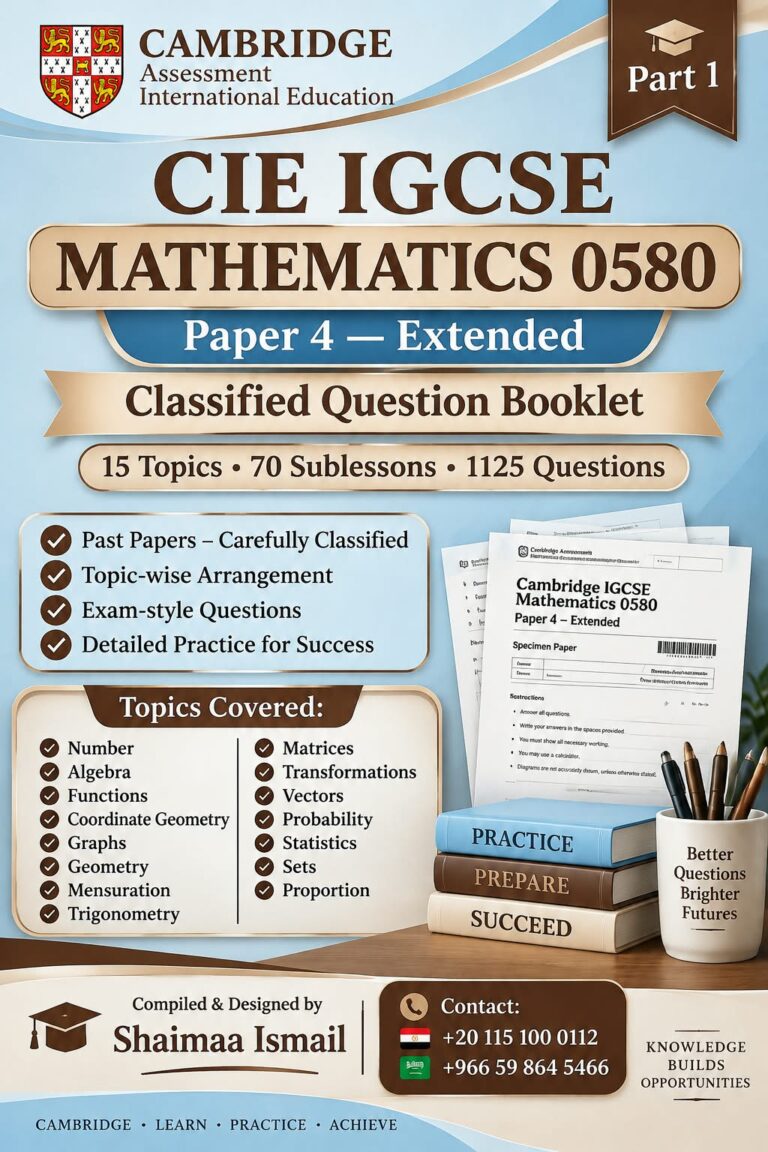
Cambridge Math OL Classified paper 4
By: Shaimaa Ismail
IGCSE · Cambridge · Grade 10, OL
FREE
View resource ↗STUDY SMARTER · IGCSE STUDY SKILLS
Make past papers part of a manageable IGCSE revision routine. Practise timing, review mistakes and use each paper to choose a useful next step.
By Wara2y Team · Published 29 June 2026 · Updated 19 November 2026
General IGCSE study guidance. Check your own examination board, syllabus code and exam year.

The IGCSE (International General Certificate of Secondary Education) exams are a major milestone in your academic journey. in order to reveal many fantastic opportunities for your future, thorough preparation for the exams is crucial. Textbooks and classroom learning provide a solid foundation for the exams preparation, still they are not enough by their own. One of the most effective steps to prepare yourself for IGCSE exams is by solving past papers.
Solving past papers is more than just practice, it is a window into the exam itself. They offer invaluable insights and helping you fine-tune your approach. This article delves into the importance of incorporating past papers into your IGCSE study
Understand the Exam Format and Structure
One of the major gains of solving past papers is that they familiarize you with the exam format. IGCSE exams usually follow a specific structure, and knowing this structure helps you to know what to expect. Hence, it can help reduce anxiety on exam day. Solving past papers gives you a clear idea of the types of questions you should expect, also, the marking scheme, and helps you with the time allocation for each section.
Identify Key Topics and Trends
Past papers reveal patterns in the types of questions that are frequently asked. Over time, you’ll notice which topics are emphasized and which ones are less likely to appear. This allows you to prioritize your study efforts and focus on high-yield areas.
Improve Time Management Skills
Time management is critical during exams. Solving past papers under timed conditions helps you practice pacing yourself and ensures that you can complete the paper within the allotted time. This is especially important for subjects like Mathematics and Sciences, where lengthy calculations and problem-solving can eat up valuable minutes.
Enhance Problem-Solving and Critical Thinking
Past papers often include challenging questions that require critical thinking and application of knowledge. Regularly tackling these questions sharpens your problem-solving skills and helps you think on your feet—a key ability for excelling in IGCSE exams.
Build Confidence and Reduce Exam Stress
The more past papers you solve, the more confident you’ll feel about your preparation. Familiarity with the exam format and question types reduces uncertainty, which in turn lowers exam-related stress. Confidence is a powerful tool that can significantly impact your performance.
Practicing past papers without a timer is like driving without a speedometer—you won’t know how fast or slow you’re going. Time management is crucial in IGCSE exams, where every second counts. If you don’t practice under timed conditions, you might find yourself running out of time during the actual exam.
Skipping over wrong answers is a missed opportunity to learn. Every mistake is a chance to improve. If you ignore them, you risk repeating the same errors in the actual exam.
Trying to solve too many past papers at once can lead to burnout. Studying should be a marathon, not a sprint. Overloading yourself with excessive practice sessions can leave you feeling exhausted and demotivated.
Here’s how to avoid burnout:
Remember, consistency is key. Regular, spaced-out practice is far more effective than last-minute cramming.

If you’re serious about IGCSE success, past papers are your secret weapon. They help you understand the exam, manage time, solve problems, and build confidence. Grab some past papers, start practicing, and watch your preparation level up.
Remember, success comes from preparation—and with past papers in your toolkit, you’re already ahead of the game. You’ve got this!
Explore options across Maths, Biology, Chemistry and Business. Check the syllabus and product contents before choosing.
DIGITAL STUDY RESOURCE
By: Shaimaa Ismail
IGCSE · Cambridge · Grade 10, OL
FREE
View resource ↗
DIGITAL STUDY RESOURCE
By: Ihsan Soayed
$19.60

DIGITAL STUDY RESOURCE
By: Maha Farid
IGCSE · Cambridge · Grade 10, OL
FREE
View resource ↗